Autoruns
2/17/2017
Contents
 Like us on Facebook
 Follow us on Twitter
Back Page 2 of 5 Next
Autostart categories
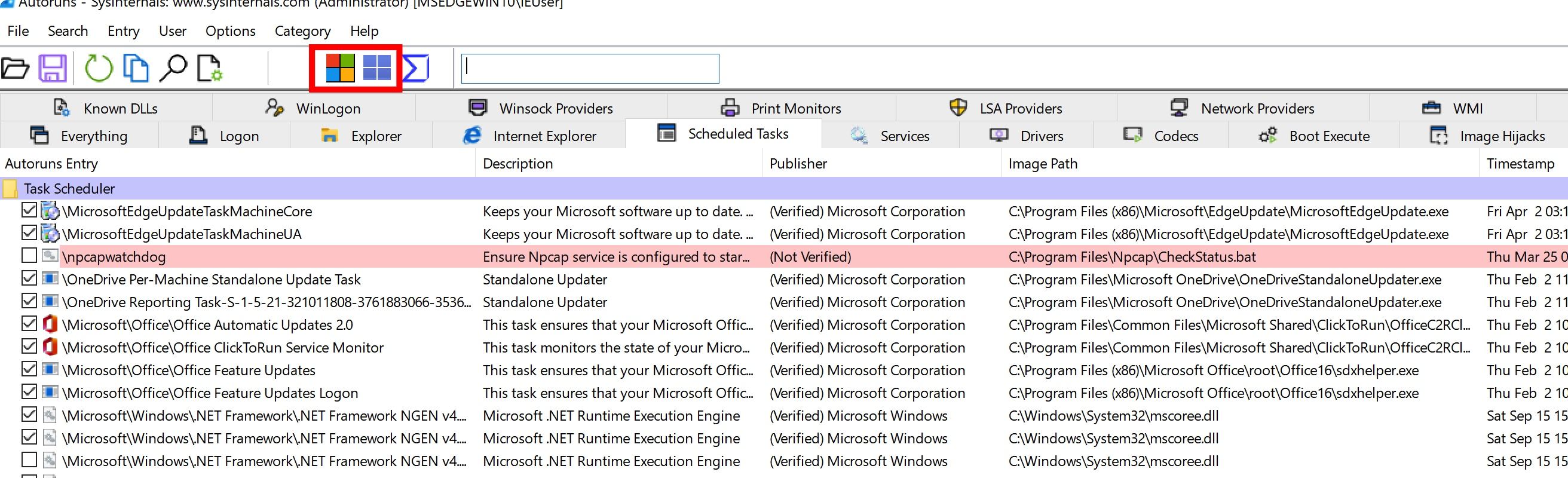
When you launch Autoruns for the first time, all autostart entries on the system are displayed in one long list on the Everything tab. As Figure 4-8 shows, the display includes up to 19 other tabs that break down the complete list into categories.

FIGURE 4-8
FIGURE 4-8 Autostart categories are displayed on up to 20 different tabs.

Logon
This tab lists the “standard” autostart entries that are processed when Windows starts up and a user logs on, and it includes the ASEPs that are probably the most commonly used by applications. They include the various Run and RunOnce keys in the registry, the Startup directories in the Start menu, computer startup and shutdown scripts, and logon and logoff scripts. It also lists the initial user session processes, such as the Userinit process and the desktop shell. These ASEPs include both per-user and systemwide locations, and entries designed for control through Group Policy. Finally, it lists the Active Setup\Installed Components keys, which although never publicly documented or supported for third-party use have been reverse-engineered and repurposed both for good and for ill.

The following lists the Logon ASEP locations that Autoruns inspects on a particular instance of an x64 version of Windows 10.

The Startup directory in the “all users” Start menu

%ALLUSERSPROFILE%\Microsoft\Windows\Start Menu\Programs\Startup
The Startup directory in the user’s Start menu

%APPDATA%\Microsoft\Windows\Start Menu\Programs\Startup
Per-user ASEPs under HKCU\Software

HKCU\Software\Microsoft\Windows\CurrentVersion\Run
HKCU\Software\Microsoft\Windows\CurrentVersion\RunOnce
HKCU\Software\Microsoft\Windows NT\CurrentVersion\Terminal Server\Install\Software\Microsoft\Windows\CurrentVersion\Run
HKCU\Software\Microsoft\Windows NT\CurrentVersion\Terminal Server\Install\Software\Microsoft\Windows\CurrentVersion\Runonce
HKCU\Software\Microsoft\Windows NT\CurrentVersion\Terminal Server\Install\Software\Microsoft\Windows\CurrentVersion\RunonceEx
HKCU\Software\Microsoft\Windows NT\CurrentVersion\Windows\Load
HKCU\Software\Microsoft\Windows NT\CurrentVersion\Windows\Run
HKCU\Software\Microsoft\Windows NT\CurrentVersion\Winlogon\Shell
Per-user ASEPs under HKCU\Software—64-bit only

HKCU\Software\Wow6432Node\Microsoft\Windows\CurrentVersion\Run
HKCU\Software\Wow6432Node\Microsoft\Windows\CurrentVersion\RunOnc
Per-user ASEPs under HKCU\Software intended to be controlled through Group Policy

HKCU\Software\Microsoft\Windows\CurrentVersion\Policies\Explorer\Run
HKCU\Software\Microsoft\Windows\CurrentVersion\Policies\System\Shell
HKCU\Software\Policies\Microsoft\Windows\System\Scripts\Logon
HKCU\Software\Policies\Microsoft\Windows\System\Scripts\Logoff
Systemwide ASEPs in the registry

HKLM\Software\Microsoft\Windows\CurrentVersion\Run
HKLM\Software\Microsoft\Windows\CurrentVersion\RunOnce
HKLM\Software\Microsoft\Windows\CurrentVersion\RunOnceEx
HKLM\Software\Microsoft\Active Setup\Installed Components
HKLM\Software\Microsoft\Windows NT\CurrentVersion\Terminal Server\Install\Software\Microsoft\Windows\CurrentVersion\Run
HKLM\Software\Microsoft\Windows NT\CurrentVersion\Terminal Server\Install\Software\Microsoft\Windows\CurrentVersion\Runonce
HKLM\Software\Microsoft\Windows NT\CurrentVersion\Terminal Server\Install\Software\Microsoft\Windows\CurrentVersion\RunonceEx
HKLM\Software\Microsoft\Windows NT\CurrentVersion\Winlogon\IconServiceLib
HKLM\Software\Microsoft\Windows NT\CurrentVersion\Winlogon\AlternateShells\AvailableShells
HKLM\Software\Microsoft\Windows NT\CurrentVersion\Winlogon\AppSetup
HKLM\Software\Microsoft\Windows NT\CurrentVersion\Winlogon\Shell
HKLM\Software\Microsoft\Windows NT\CurrentVersion\Winlogon\Taskman
HKLM\Software\Microsoft\Windows NT\CurrentVersion\Winlogon\Userinit
HKLM\Software\Microsoft\Windows NT\CurrentVersion\Winlogon\VmApplet
HKLM\System\CurrentControlSet\Control\SafeBoot\AlternateShell
HKLM\System\CurrentControlSet\Control\Terminal Server\Wds\rdpwd\StartupPrograms
HKLM\System\CurrentControlSet\Control\Terminal Server\WinStations\RDP-Tcp\InitialProgram
Systemwide ASEPs in the registry, intended to be controlled through Group Policy

HKLM\Software\Microsoft\Windows\CurrentVersion\Policies\Explorer\Run
HKLM\Software\Microsoft\Windows\CurrentVersion\Policies\System\Shell
HKLM\Software\Policies\Microsoft\Windows\System\Scripts\Logon
HKLM\Software\Policies\Microsoft\Windows\System\Scripts\Logoff
HKLM\Software\Policies\Microsoft\Windows\System\Scripts\Startup
HKLM\Software\Policies\Microsoft\Windows\System\Scripts\Shutdown
HKLM\Software\Microsoft\Windows\CurrentVersion\Group Policy\Scripts\Startup
HKLM\Software\Microsoft\Windows\CurrentVersion\Group Policy\Scripts\Shutdown
Systemwide ASEPs in the registry—64-bit only

HKLM\Software\Wow6432Node\Microsoft\Windows\CurrentVersion\Run
HKLM\Software\Wow6432Node\Microsoft\Windows\CurrentVersion\RunOnce
HKLM\Software\Wow6432Node\Microsoft\Windows\CurrentVersion\RunOnceEx
HKLM\Software\Wow6432Node\Microsoft\Active Setup\Installed Components
Systemwide ActiveSync ASEPs in the registry

HKLM\Software\Microsoft\Windows CE Services\AutoStartOnConnect
HKLM\Software\Microsoft\Windows CE Services\AutoStartOnDisconnect
Systemwide ActiveSync ASEPs in the registry—64-bit only

HKLM\Software\Wow6432Node\Microsoft\Windows CE Services\AutoStartOnConnect
HKLM\Software\Wow6432Node\Microsoft\Windows CE Services\AutoStartOnDisconnect
引导执行选项卡显示了系统在引导期间由会话管理器(smss.exe)启动的windows本机模式可执行文件。启动引导通常包含windows运行时无法执行的任务,例如硬盘验证和修复(autochk.exe)。在windows安装后,Execute、S0InitialCommand和SetupExecute条目永远不应该被修改。下面列出了Boot Execute选项卡上显示的键。
Keys that are displayed on the Boot Execute tab
Winlogon标签显示与winlogon.exe挂钩的的条目,winlogon.exe管理windows交互登陆用户界面。在windows vista中引入凭据提供者接口管理用户身份验证接口。今天,windows包括很多凭证提供程序,处理密码、PIN、图片密码、智能卡和生物识别登陆。如果你禁用“Hide Windows Entry Option”选项才会显示其中大部分内容。第三方也可以提供进一步交互式用户登陆凭证。
Per-user specification of the screen saver
HKCU\Control Panel\Desktop\Scrnsave.exe
Per-user specification of the screen saver, controlled by Group Policy